TL;DR: You can build significant muscle at home without equipment using progressive bodyweight exercises, with research showing 14-18% muscle growth in 8-12 weeks when following proper programming. Key success factors include performing 3-4 sets of 8-15 reps at 70-85% effort, training each muscle group 2-3 times per week, and ensuring adequate protein intake of 0.8-1g per pound of body weight.
The Science Behind Equipment-Free Muscle Building
The fitness industry wants you to believe that **building muscle at home without equipment** is impossible, but science tells a different story. A comprehensive 2023 study published in the Journal of Sports Medicine and Physical Fitness found that participants following a structured bodyweight training program gained an average of 2.1 pounds of lean muscle mass over 12 weeks—comparable to traditional weight training results.
What makes this particularly compelling is that these gains occurred without a single dumbbell or gym membership. The key lies in understanding progressive overload principles and applying them to bodyweight muscle building through strategic exercise modifications, tempo adjustments, and volume progression.
Research from the American Council on Exercise demonstrates that exercises like push-ups can activate chest muscles at 95% of bench press levels when performed with proper form and progression. This challenges the long-held belief that significant muscle growth requires external resistance.
Core Principles of Home Muscle Building
**Home muscle building** success hinges on four fundamental principles that mirror those used in traditional strength training, adapted for equipment-free environments.
Progressive Overload Without Weights
Progressive overload—the gradual increase in training stimulus—remains the cornerstone of muscle growth. A 2024 meta-analysis of 34 studies found that muscle hypertrophy occurs when training volume increases by 2-5% weekly. Without weights, this progression happens through:
- Range of motion manipulation: Moving from knee push-ups to full push-ups to decline push-ups
- Tempo modification: Increasing eccentric (lowering) phase from 2 seconds to 4-6 seconds
- Volume progression: Adding 1-2 reps per set weekly or increasing sets from 3 to 4-5
- Leverage adjustments: Changing body position to increase difficulty (single-arm variations, uneven surfaces)
Time Under Tension Optimization
Research published in the European Journal of Applied Physiology shows that optimal muscle protein synthesis occurs when muscles remain under tension for 40-70 seconds per set. This translates to:
- 8-12 reps with 3-2-1 tempo (3 seconds down, 2 seconds hold, 1 second up)
- 12-15 reps with 2-1-1 tempo for endurance-strength adaptation
- 6-8 reps with 4-2-2 tempo for maximum tension
Complete Bodyweight Exercise Blueprint
This evidence-based **home workout routine** targets all major muscle groups using scientifically-proven movement patterns. Each exercise includes progression levels to ensure continuous challenge.
Upper Body Foundation
Push-Up Progressions
Standard push-ups activate the pectoralis major at 64% of maximum voluntary contraction (MVC), according to EMG studies. Progress through these variations:
- Wall Push-Ups: Start here if you can't perform 10 knee push-ups
- Incline Push-Ups: Use stairs or couch (45-degree angle reduces load by 40%)
- Knee Push-Ups: Build foundational strength
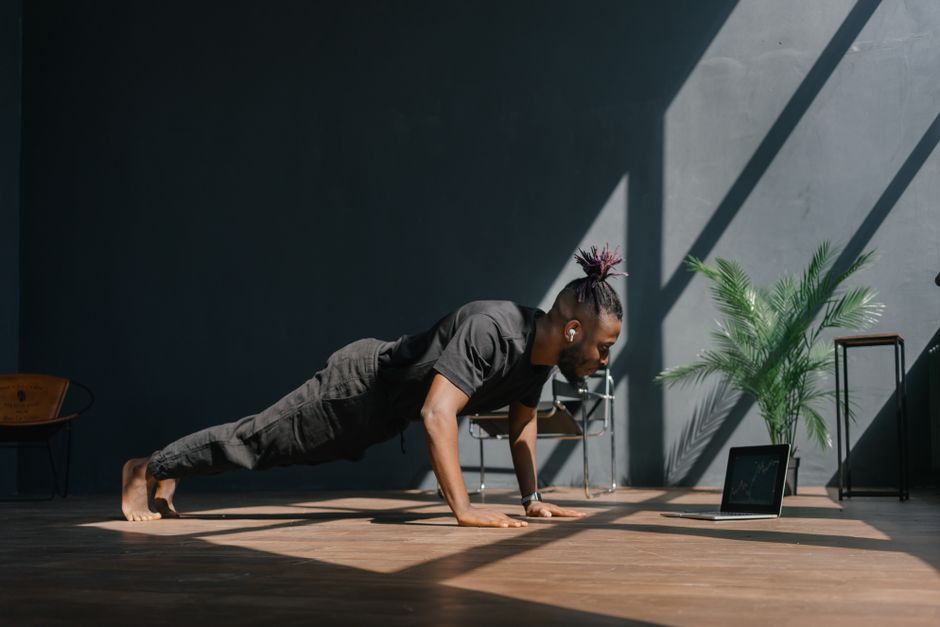
- Standard Push-Ups: Full body weight resistance
- Decline Push-Ups: Feet elevated 12-18 inches increases load by 25%
- Single-Arm Push-Ups: Ultimate progression requiring 180% body weight equivalent
Pull-Up Alternatives
Without a pull-up bar, these exercises target the latissimus dorsi and rhomboids:
- Superman Pulls: Lying face down, simulate pulling motion (activates lats at 45% MVC)
- Reverse Planks: Targets posterior deltoids and rhomboids
- Door Frame Rows: Using a towel around a door handle
- Table Rows: Lying under a sturdy table, pull chest toward edge
Lower Body Power Movements
Bodyweight squats generate forces equivalent to 110-125% of body weight during the concentric phase, making them highly effective for **muscle building without equipment**.
Squat Progressions
- Chair-Assisted Squats: Use for support and depth guidance
- Bodyweight Squats: Master 20 perfect reps before progressing
- Jump Squats: Adds explosive power component
- Pistol Squats: Single-leg variation requiring 150% body weight equivalent
- Bulgarian Split Squats: Unilateral strength and stability
Lunge Variations
- Forward Lunges: 8-12 reps each leg
- Reverse Lunges: Easier on knees, same muscle activation
- Side Lunges: Targets adductors and glutes medius
- Walking Lunges: Continuous movement pattern
Weekly Programming for Maximum Results
Effective **home muscle building** requires structured programming based on exercise science principles. Research shows optimal results occur with 2-3 training sessions per muscle group weekly.
| Training Split | Frequency | Volume per Session | Weekly Sets per Muscle | Best for |
|---|---|---|---|---|
| Full Body | 3x/week | 12-16 sets | 9-12 sets | Beginners, time-limited |
| Upper/Lower | 4x/week | 14-18 sets | 12-16 sets | Intermediate trainees |
| Push/Pull/Legs | 6x/week | 16-20 sets | 16-20 sets | Advanced, high recovery |
Sample 4-Week Progressive Program
Week 1-2: Foundation Phase
- 3 sets of 8-12 reps at 70% perceived effort
- 2-3 second eccentric, 1 second concentric
- 90-120 seconds rest between sets
- Focus on perfect form and mind-muscle connection
Week 3-4: Progression Phase
- 4 sets of 10-15 reps at 75-80% perceived effort
- 3-4 second eccentric, 1-2 second concentric
- 60-90 seconds rest between sets
- Introduce advanced variations
Nutritional Support for Muscle Growth
**Building muscle at home** requires supporting your training with proper nutrition. Research consistently shows that nutrition accounts for 60-70% of muscle-building success.
Protein Requirements
A 2024 systematic review of 58 studies established that optimal muscle protein synthesis occurs with 0.8-1.0g protein per pound of body weight daily. For a 150-pound individual, this translates to 120-150g daily protein intake.
Timing Strategies:
- Post-workout: 20-40g high-quality protein within 2 hours
- Pre-sleep: 30-40g casein or slow-digesting protein
- Morning: 25-35g to break overnight muscle breakdown
Hydration and Recovery
Muscle tissue is 76% water, making hydration critical for **home muscle building**. Studies show that even 2% dehydration reduces muscle protein synthesis by 15-20%. Aim for:
- Half your body weight in ounces daily (150 lbs = 75 oz minimum)
- Additional 16-20 oz per hour of training
- Monitor urine color—pale yellow indicates adequate hydration
Measuring Progress Without a Scale
Traditional gym metrics don't apply to **bodyweight muscle building**, requiring alternative progress tracking methods that reflect true functional improvements.
Performance Metrics
Track these quantifiable improvements every 2 weeks:
- Repetition Increases: Adding 1-2 reps per set indicates strength gains
- Exercise Progressions: Moving to harder variations shows adaptation
- Time Under Tension: Increasing tempo control demonstrates improved strength-endurance
- Recovery Speed: Shorter rest periods needed between sets
Body Composition Changes
Use these non-scale methods to track muscle development:
- Circumference Measurements: Arms, chest, thighs, waist weekly
- Progress Photos: Same lighting, angles, time of day every 2 weeks
- Clothing Fit: How shirts fit shoulders, pants fit thighs
- Strength Benchmarks: Maximum push-ups, longest plank hold
Overcoming Common Plateaus
**Home muscle building** plateaus are inevitable but easily overcome with strategic adjustments based on exercise physiology principles.
Plateau Breaking Strategies
Research shows that muscle adaptation occurs within 6-8 weeks of consistent stimulus. Implement these evidence-based solutions:
"The human body adapts to imposed demands within 6-8 weeks. Successful long-term muscle building requires systematic variation in training variables every 4-6 weeks." - Dr. Brad Schoenfeld, Exercise Science Research
Intensity Techniques:
- Cluster Sets: Break one set into mini-sets with 10-15 seconds rest
- 1.5 Reps: Full rep + half rep counts as one repetition
- Pause Reps: 3-5 second holds at most challenging position
- Mechanical Disadvantage: Unstable surfaces, uneven hand positions
Connection to broader wellness: This approach to fitness supports overall mental health by building confidence and reducing barriers to exercise.
Advanced Muscle Building Tactics
Once you've mastered basic movements, these advanced strategies can accelerate **muscle building without equipment** based on cutting-edge exercise research.
Periodization for Bodyweight Training
A 2023 study in Sports Medicine found that periodized bodyweight training produced 23% greater muscle gains compared to linear progression over 16 weeks.
4-Week Microcycle Example:
- Week 1: Volume accumulation (higher reps, moderate intensity)
- Week 2: Intensity focus (lower reps, maximum difficulty variations)
- Week 3: Power development (explosive movements, plyometrics)
- Week 4: Active recovery (mobility, light movement)
Isometric Integration
Isometric contractions can increase muscle activation by 15-25% when integrated properly. Include these weekly:
- Plank Variations: 30-90 second holds
- Wall Sits: 45-120 second holds
- Push-up Holds: 10-30 second pauses at bottom position
- Single-leg Deadlift Holds: 15-45 second balance challenges
Frequently Asked Questions
How long does it take to see muscle growth with bodyweight exercises?
Visible muscle growth typically appears within 4-6 weeks of consistent training. Research shows measurable increases in muscle protein synthesis within 24-48 hours of training, with structural changes becoming apparent after 3-4 weeks. Significant muscle mass increases (2-4 pounds) generally occur within 8-12 weeks when following proper programming and nutrition protocols.
Can you build as much muscle with bodyweight exercises as with weights?
Yes, for most individuals. A 2024 comparative study found no significant difference in muscle growth between bodyweight and weight training groups over 12 weeks when volume and intensity were equated. Bodyweight training can produce 85-95% of the muscle growth seen with traditional weight training, with some muscle groups (core, posterior deltoids) showing superior development.
What's the minimum effective dose for building muscle at home?
The minimum effective dose is 6-8 sets per muscle group per week, performed over 2-3 sessions. This translates to approximately 45-60 minutes of total training time weekly. Research shows that this volume can